Theoretical position
A non-reductionist model
Rooted in Piaget’s equilibration and later developments, the model shares the naturalist, non-reductionist approach of emergentism: brain processes cause mental processes, but psychology’s macro level and neuroscience’s micro level remain distinct.
These are two descriptions of one constructed reality. Brain imagery suggests plausible parallels rather than systematic correspondences between psychological and neural constructs.
Constructs
Components of the model
- EeSpecific schemas
- Content-dependent: physical-inert (Eef), emotional (Eee) and intentional (Eei). They assign meaning.
- EgGeneral schemas
- Built through reflection: operational (Ego), sentimental (Egs) and grammatical (Egg).
- HfFigurative thinking
- Signs, symbols, graphics and images: the semiotic or sensory basis of declarative expression.
- PcCentral processor
- Coordinates and sequences Ee, Hf and Eg activity according to demands.
- RiRepresentation of interaction
- The sensory-memory trace of external sensorimotor (Ie) or semiotic (Is) interaction.
Procedural response
A = Eg [ Ee + Ri ]
Environmental action mobilises specific schemas, modulated by general ones.
Declarative response
D = Eg [ Ee + Hf + Ri ]
Speech and writing also require connections between schemas and figurative thinking tools.
Dichotomous system
Four pairs guiding the model
Less adequate · Meaning as definition
Meaning treated as a grammatical collection of signifiers, as in dictionaries and academic definitions.
More adequate · Organic meaning
An organic whole assigned internally through body, cognition and emotion: what it prepares the subject to do, say or feel.
Less adequate · Correspondence
Substantively connecting old and new ideas, assuming causal teaching-learning links or examining only initial and final states.
More adequate · Internal construction
Construction always occurs inside the subject, however favourable the teaching conditions.
Less adequate · Symbolic processor
The mind treated as a symbolic processor or grammatical conceptual network reduces procedures to syntax.
More adequate · Schema
An embodied, procedural view in which schemas describe knowledge better than concepts.
Less adequate · Logical interpretation
Academic logic can make subjects appear inconsistent, fragmented or confused.
More adequate · Psychological interpretation
A framework faithful to psychological evidence reveals coherent, pragmatic knowledge arising from self-regulation.
Specific constructions
Two information sources: Ie and Is
In sensorimotor interactions (Ie), objects provide raw experiential data. Meaning is assigned through assimilation and schemas readjust through accommodation: the integration is an organic process of trial, adjustment and revision requiring time and emotional engagement.
In semiotic interactions (Is), subjects already know something of shared signs, usually words. Social experience continually enriches meaning: easier than raw-data integration, but still not direct appropriation.
First level
Three domains of specific schemas
Eef
Physical-inert domain
Eee
Emotional domain
Eei
Intentional domain
Possible neural parallels include motor, sensory, spatial, auditory and balance areas, particularly Wernicke’s area, associated with interpretation. This is a proposed parallel, not an established mapping.
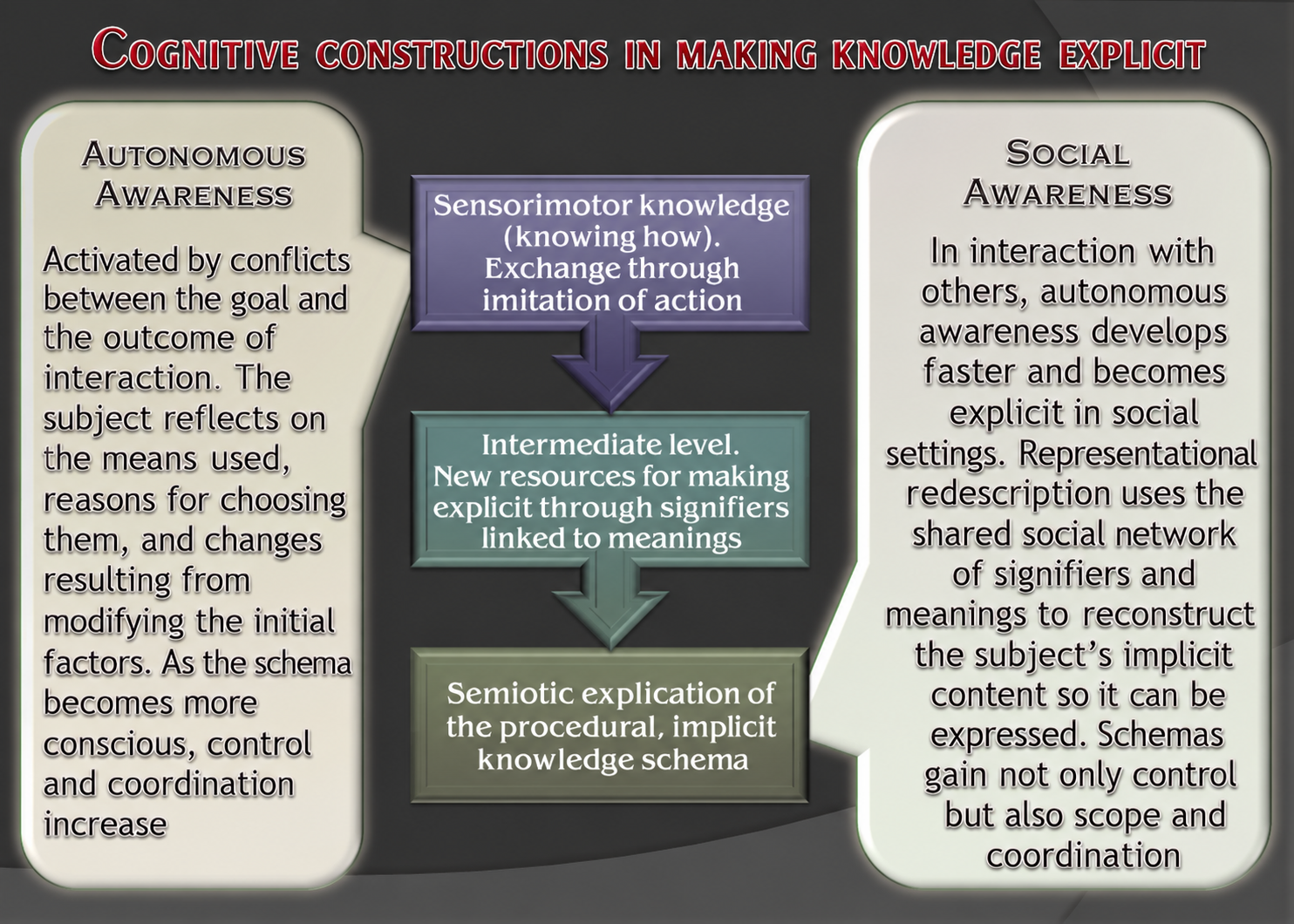
Read the diagram text
- Cognitive constructions in making knowledge explicit
- Autonomous awareness
- Activated by conflicts between the goal and the outcome of interaction. The subject reflects on the means used, reasons for choosing them, and changes resulting from modifying the initial factors. As the schema becomes more conscious, control and coordination increase
- Sensorimotor knowledge (knowing how). Exchange through imitation of action
- Intermediate level. New resources for making explicit through signifiers linked to meanings
- Semiotic explication of the procedural, implicit knowledge schema
- Social awareness
- In interaction with others, autonomous awareness develops faster and becomes explicit in social settings. Representational redescription uses the shared social network of signifiers and meanings to reconstruct the subject’s implicit content so it can be expressed. Schemas gain not only control but also scope and coordination
From implicit to explicit
Figurative tools, awareness and declarative knowledge
The figurative thinking tools (Hf) enable communication and thinking beyond sensorimotor resources. Schemas assign their meanings, creating Hf-Ee relationships that strengthen and become automatic.
Interpersonal interaction involves the S-C: communication expands shared Hf and aligns meanings. The model hypothesises a link with the arcuate fasciculus connecting Broca’s and Wernicke’s areas.
Awareness progresses from exercising a schema, to activating it with recalled objects, to socially supported explicit expression through cooperation and correction.
The model proposes that declarative knowledge is not a permanent schema version but a temporary process of association with Hf, explaining the weak correlation between doing and explaining.
Second level
General schemas and central processor
General schemas develop through sustained cognitive and emotional reflection on first-level procedures and content, and later on explicit knowledge.
The operational schemas (Ego) arise through reflective abstraction on specific-schema regulation. The sentimental schemas (Egs) make emotional schemas explicit through values and norms. Desires often underlie apparently rational arguments; prefrontal and limbic systems are closely connected. The grammatical schemas (Egg) connect semiotic materials through grammatical chains built by Hf-Ee re-equilibration, unlike Chomsky’s innate account.
The central processor (Pc) coordinates executive functions, with prefrontal parallels, sequencing schema and Hf activity. It covers functions Baddeley distributes across the central executive, episodic buffer and working memory.
Conclusions
What this model contributes
01
New constructions
02
Organic coherence
03
Awareness and making explicit
04
Emotion and feeling
05