Towards integration
No mind without culture, no culture without mind
Strong social influence can suggest that knowledge forms outside and enters the mind by osmosis. This contradicts the constructivist principle that every cognitive construction is internal.
Moderate approaches increasingly combine internal mental processes with the influence of culturally organised communities. Organic Constructivism proposes a theoretical integration—the CiS—which respects two principles: knowledge is constructed within the subject’s mind, and incoming information is always given meaning internally.
Extreme positions treating society as irrelevant or wholly sufficient are rejected. Piaget sees social facilitation and shaping; Vygotsky sees social necessity without sufficiency.
Two paths of interaction
Direct experience matters too
- 1Implicit procedural learning, such as navigation, crossing roads and balancing objects, has adaptive value with little semiotic mediation.
- 2Direct experience predominates during the first two years; the earliest meanings, in development and evolution, are sensorimotor.
- 3Sensorimotor schemas support language acquisition through symbolic play and the differentiation of signifier and meaning.
- 4Basic colour categories and the emotional palette show universal predispositions beyond cultural vocabulary.
- 5Awareness and operational schemas often originate in regulating object-directed actions and their outcomes.
Recent contributions
Piaget and Vygotsky compared
Piaget
Piaget details internal construction but subordinates social processes to individual ones. His physical examples overlook a differentiated environment of artefacts, signs and people.
Read the full critique →Vygotsky
Vygotsky captures cultural transformation but offers an optimistic account of instruction and insufficient psychological mechanisms. Without schemas, words remain meaningless sounds.
Read the full critique →Key 1
Avoid mechanical combinations
Key 2
Consider social order within the mind
The solution
The organic semiotic-community system (S-C)
01
What in the S-C system affects its members?
02
How is socially assigned meaning shared?
03
How are signifier-meaning relationships internalised?
S-C recognises social progress through synergy that exceeds individual contributions. Although resembling Wenger’s communities of practice, it differs by distinguishing information, knowledge, signifiers, meanings, teaching and learning.
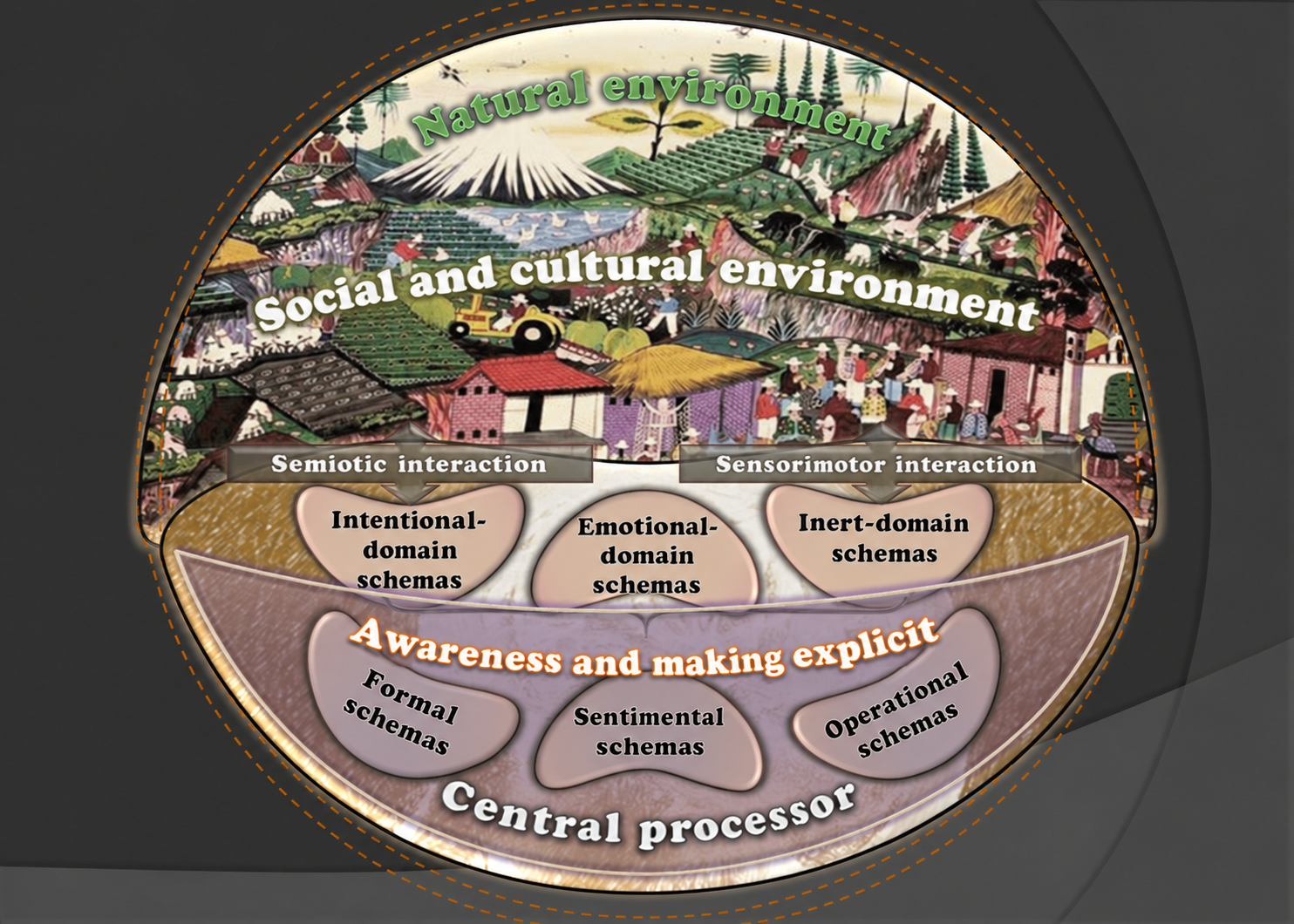
Read the diagram text
- Natural environment
- Social and cultural environment
- Semiotic interaction
- Sensorimotor interaction
- Intentional-domain schemas
- Emotional-domain schemas
- Inert-domain schemas
- Awareness and making explicit
- Formal schemas
- Sentimental schemas
- Operational schemas
- Central processor
New constructive processes
Construction through social interaction
Through physical interaction with the social environment. Intentional schemas anticipate people’s behaviour; emotional schemas give decisions an affective valence and a somatic indication of how the world affects the organism.
Through awareness. The social echo of behaviour enriches awareness. Sharing experience requires declarative expression in a common semiotic system, bringing representational redescription and new ways of thinking.
Through semiotic reflection. Reflection on semiotic representations creates new objects and relationships and expands possibilities. Signifiers work through their meaning relationships, even when practice makes them rapid, as in mathematics.