Teaching foundations
Building structures that assign meaning
Definitions, formulas and explanations are necessary but insufficient. Learners need schemas that assign meaning and integrate new knowledge through their own activity.
When the euro arrived, amounts initially meant little. Shopping, currency conversion and comparison with the effort of earning gave them meaning. Content acquires personal meaning in the same way.
The AcA model
Four teaching guidelines
Guideline A
Distinguish and emphasise meaning over signifiers
Teaching centred on signifiers leaves little opportunity to assign meaning when schemas are missing. Schema-based meaning needs more learning time.
- For topics such as recycling and pollution, existing basic meanings may make explanations, discussions and research sufficient.
- Without prior schemas, concepts become rote, flat knowledge that cannot transfer.
- Understanding a definition does not guarantee integration: learners must engage with the concrete objects and situations it describes.
Guideline B
Recontextualise
Use varied practical contexts and relevant and irrelevant changes within each. This builds meaning and procedures for applying content, but requires more time per topic.
- Vc · Contextual variation: two or three engaging practical contexts per topic, framed as problems.
- Vd · Difficulty variation: from simple causal relationships to situations with more objects and interactions.
- Vr / Vi · Relevant and irrelevant variation: change factors that affect outcomes and others that do not, revealing regularities and exceptions.
Guideline C
Create an engaging, expectant context
Increase opportunities for imbalance and re-equilibration through cognitive and emotional engagement. Activities should create productive tension with peers and teachers, like a riddle everyone wants to solve.
- No imbalance occurs when learners disengage, deny the disturbance, see it as irrelevant or cannot assimilate radically new information.
- Ask learners how to reach a goal, investigate by manipulating objects, or predict and compare predictions with experience.
- Do not provide solutions at the start: this inhibits cognitive effort, the basis of guided discovery teaching.
Guideline D
Develop new meanings
Encourage reflection through commitment and sustained semiotic interaction. Recontextualisation stresses sensorimotor activity; developing meanings stresses speaking, arguing, representing, writing and debating.
- Awareness: use activities with visible outcomes; reflect first on action and result, then on the means used.
- Making explicit: reasoned discussions within and between groups put implicit content into words.
- Operating and formalising: vary and compare content to construct underlying operations, then reflect on semiotic materials supported by an empirical foundation.
The textbook
Why school science can seem meaningless
Science’s information networks—its declarative version—become knowledge through a community that uses them. Successive filtering and formalisation strip away the original problems, inquiry and authors’ understanding before a school version is produced.
Students encounter signifiers without their original context or an expert mind to interpret them. Inertia, for instance, may seem impossible to connect with everyday experience.
It therefore helps to distinguish the understanding of a concept (its defining attributes) from its extension (the objects it refers to). Clear explanations can bring quick understanding; integration requires open-ended activities involving doubt, revision and trial and error.
Synthesis
Two central strategies: recontextualise and develop meanings
Recontextualise
empirical interaction · meanings
Practical contexts give content meaning and enrich schemas through cognitive conflict and re-equilibration.
- VcContextual variation
- VdDifficulty variation
- VrRelevant variation
- ViIrrelevant variation
Develop new meanings
semiotic interaction · signifiers
Share meanings within and between groups, then engage with books, teachers and the internet through making explicit, operating and formalising.
- DgWithin-group discussion
- DiBetween-group discussion
- MsSemiotic materials
- DpProximal development
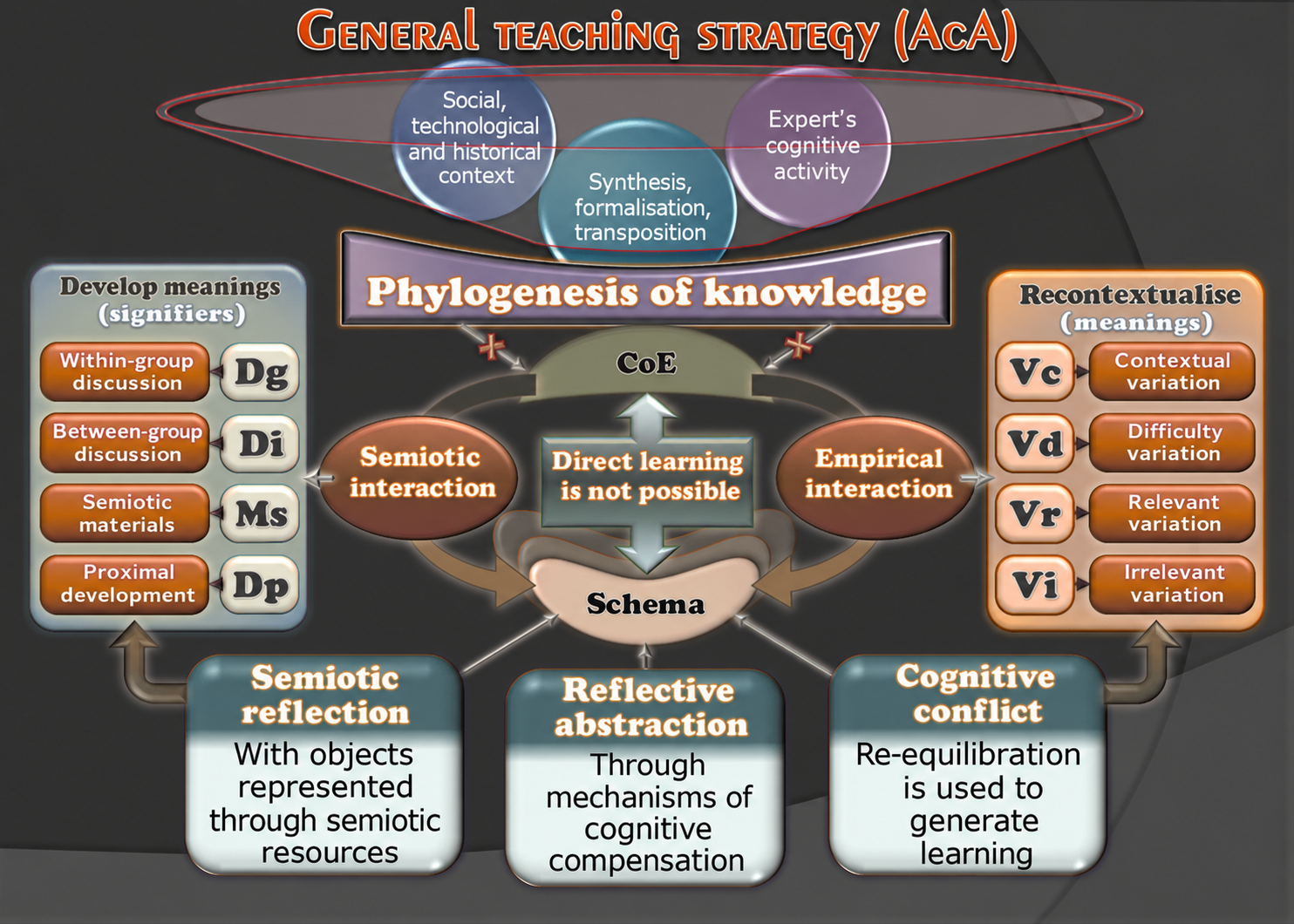
Read the diagram text
- General teaching strategy (AcA)
- Social, technological and historical context
- Expert’s cognitive activity
- Synthesis, formalisation, transposition
- Phylogenesis of knowledge
- Develop meanings (signifiers)
- Within-group discussion
- Between-group discussion
- Semiotic materials
- Proximal development
- Recontextualise (meanings)
- Contextual variation
- Difficulty variation
- Relevant variation
- Irrelevant variation
- Semiotic interaction
- Empirical interaction
- Direct learning is not possible
- Schema
- Semiotic reflection
- With objects represented through semiotic resources
- Reflective abstraction
- Through mechanisms of cognitive compensation
- Cognitive conflict
- Re-equilibration is used to generate learning
Teaching sequence
First the problem, then the information
Initial activities encourage cognitive effort on problems; meaningful information supporting solutions comes later. This is the sequence of guided discovery teaching.
Teachers design, organise and facilitate activities, contribute to debates and raise questions that invite reflection. Their decisive intervention supports learners’ internal construction.
Procedural learning is even harder than learning specific content: strategies require sustained work across many topics and contexts.
Comparison
Student as Learner versus Student as Scientist
Student as Learner (AcA)
Teaching follows individual psychological processes: meaning-making, schema integration, re-equilibration, awareness, reflective abstraction and formalisation. Experts’ internal constructions do not appear in scientific publications.
Student as Scientist (AcC)
Conceptual change, alternative conceptions and inquiry teaching assume parallels between science and learners. Organic Constructivism finds these stronger on teaching conditions than learning mechanisms, favouring assimilation, accommodation and differentiation over cognitive replacement.