Starting point
Learning as organic self-regulation
Organic Constructivism studies cognitive organisation and learning using the living organism as a model. When imbalances, disturbances or conflicts occur, the cognitive system compensates and reaches new equilibria, producing new cognitive constructions.
Although cognitive structure becomes increasingly balanced, the continuing gap between cognition and reality generates new imbalances. Learning therefore never ends.
Its basic organisational unit is the knowledge schema, which both accumulates constructions organically and regulates interactions between subject and environment. Each domain requiring adaptation has a schema, physically realised in a network of neural synapses.
Overview
Six ways of learning
Through external interaction
- Memorisingsin asimilar ni acomodar
- Information enters memory without a schema giving it meaning, either because none is needed (a phone number) or because the relevant schema is absent (the concept of an ion).
- Understandingasimilar sin acomodar
- An available schema gives meaning to a signifier: grasping a sense, making connections, anticipating, completing a figure or predicting an effect.
- Integratingasimilar y acomodar
- Information is assimilated and the schema is reorganised to incorporate it. Knowledge becomes embodied and usable in new situations.
Through internal interaction (reflection)
- Making explicittomar conciencia
- The implicit, procedural schema becomes progressively conscious and expressible through socially shared signifiers.
- Operatingreflexionar sobre las regulaciones
- Repeated reflection on compensating for imbalances generates higher-order operational schemas.
- Formalisingreflecting on explicit knowledge
- Reflection on content already represented by signs builds culture’s most abstract concepts: constructivism, inflation and mathematical objects.
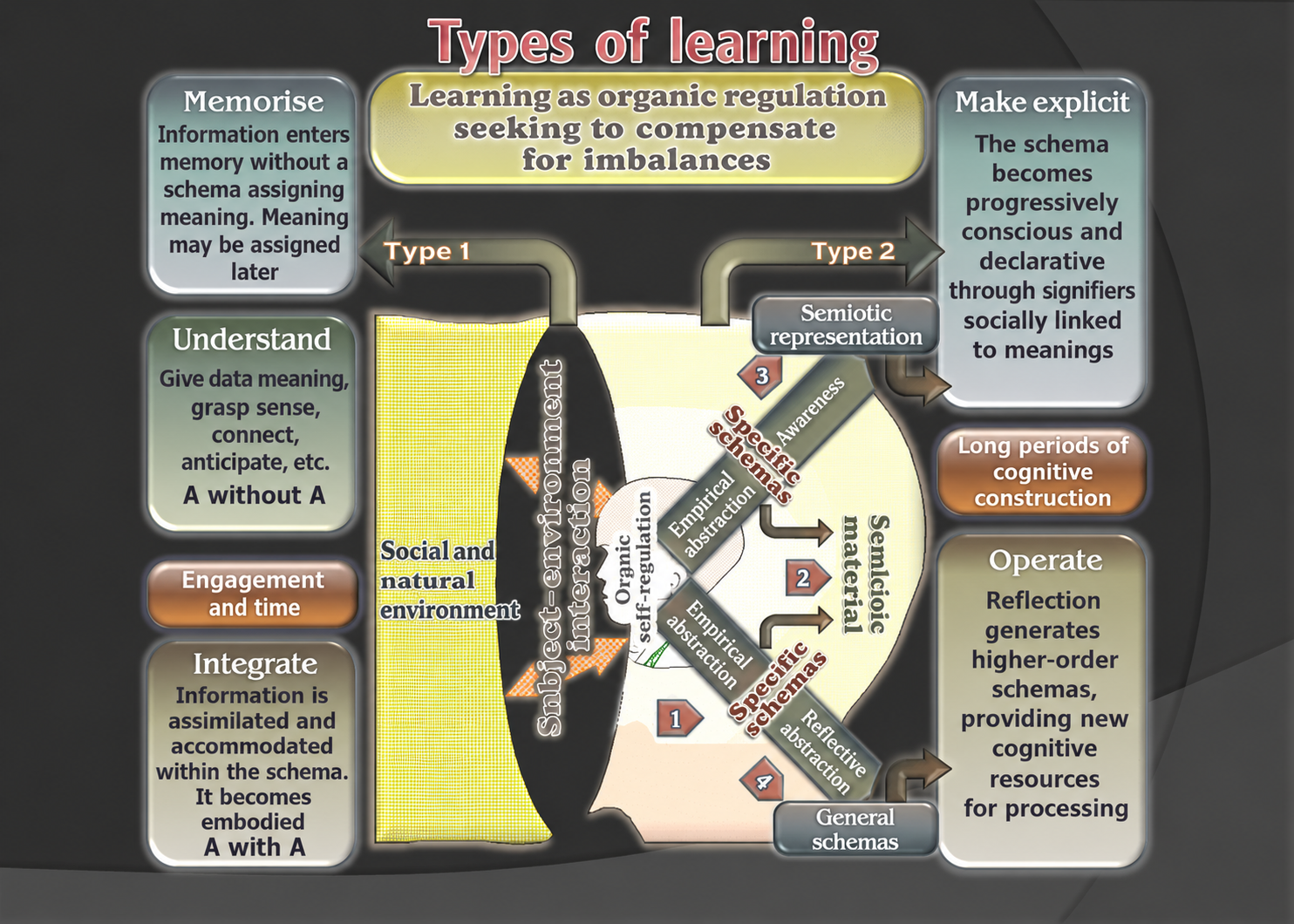
Read the diagram text
- Types of learning
- Learning as organic regulation seeking to compensate for imbalances
- Memorise
- Information enters memory without a schema assigning meaning. Meaning may be assigned later
- Understand
- Give data meaning, grasp sense, connect, anticipate, etc.
- A without A
- Engagement and time
- Integrate
- Information is assimilated and accommodated within the schema. It becomes embodied
- A with A
- Make explicit
- The schema becomes progressively conscious and declarative through signifiers socially linked to meanings
- Long periods of cognitive construction
- Operate
- Reflection generates higher-order schemas, providing new cognitive resources for processing
- Type 1
- Type 2
- Social and natural environment
- Subject–environment interaction
- Organic self-regulation
- Empirical abstraction
- Specific schemas
- Semiotic material
- Awareness
- Semiotic representation
- Reflective abstraction
- General schemas
Cognitive organisation
Schemas at two levels
Level 1 · Specific schemas (Ee)
EefPhysical-inert domain
Orientation, personal and object balance, predicting a moving object’s position, and objects’ solidity and inertia.
EeeEmotional domain
The emotional valence of actions and decisions activates or inhibits interaction with objects according to the relationship with them.
EeiIntentional domain
Beliefs, norms, values and cultural knowledge used to belong to a group or choose appropriate clothing and vocabulary.
Pc
Central processor
Level 2 · General schemas (Eg)
EgoOperational schemas
Internalised, reversible actions built through reflective abstraction on the general coordination of actions.
EgsSentimental schemas
They organise evaluations, norms and emotional response patterns, modulating the assimilatory activity of specific schemas.
EggGrammatical schemas
They connect semiotic materials into grammatical chains to express knowledge declaratively.
These are complemented by the figurative thinking tools —verbal signifiers, signs, symbols and mental images—which lack transformative capacity but are essential for constructing declarative expressions in context.
A · Interaction with the environment
Constructions linked to specific schemas
A1. Progress without construction. Memorising and understanding can provide cognitive progress without imbalance or restructuring. Understanding may include inferences—anticipating a text’s meaning, completing a figure, predicting, classifying or ordering—that require no construction.
A2. Enrichment, differentiation and coordination. Every construction in a specific schema follows a disturbance, though not every disturbance produces construction. Learning cannot be reduced to adding or associating: like an organism digesting nutrients, a schema must assimilate —transform and interpret information—and accommodate —restructure so that new material is integrated—.
The same processes apply between schemas. Through coordination or reciprocal assimilation, schemas cooperate to meet an environmental demand; through progressive differentiation, a richly developed schema splits into more precise ones. More schemas allow greater accommodation.
Key idea
Understanding is not integrating
Put simply, there is integration when assimilation and accommodation enrich the schema; understandingwith assimilation alone; and memorisation when information is retained without assimilation or accommodation. Understanding and memorising may bring progress, but only integration involves construction.
A learner may understand an explanation without integrating it: understanding does not ensure long-term retention. Transfer requires sustained interaction with varied contexts and problems, beyond clear explanations.
Moving from understanding to integration requires emotional engagement: repeatedly returning to resistant information despite successive cognitive conflicts.
B · Internal interaction
Reflective abstraction and operational schemas
B1. Long-term reflection on how specific schemas compensate for imbalances, repeated in diverse contexts, builds an operational schema. This reflective abstraction reorganises lower-level processes at a higher level; the new schema then modulates specific schemas.
Unlike physical actions, operational schemas act mentally on representations and are reversible: combining can be reversed by separating. When children discover that ten stones remain ten however they are arranged, their own arranging and counting actions are decisive: number is not in the stones.
Specific schemas are necessary; sufficient conditions depend on the quality and quantity of interactions involving cognitive conflict, time for reflection and personal interest.
B3. Organic regulation never stops: any reflective construction may itself become an object of reflection. Applied to explicit cultural content, this metacognitive continuum explains abstract concepts such as constructivism, inflation and mathematical objects.
B2 · Making explicit and social interaction
From knowing how to knowing how to explain
Development eventually brings more learning through cultural signifiers than physical interaction. How can a slight vibration in the ear or a mark on paper change a schema built over years? The change comes from the meaning assigned, rather than the signifier itself.
Schemas are initially implicit, used without awareness. The autonomous development of awareness starts from the observable goal and success or failure of an action, then examines the means used. It increases control, coordination and declarative recall of schemas.
The socially mediated awareness adds a mechanism Piaget did not address: behaviour acquires a social echo that accelerates awareness and gives rise to representational redescription, reconstructing implicit content at a more refined level through shared signifiers and meanings.
B4 · Emotional system