Architecture
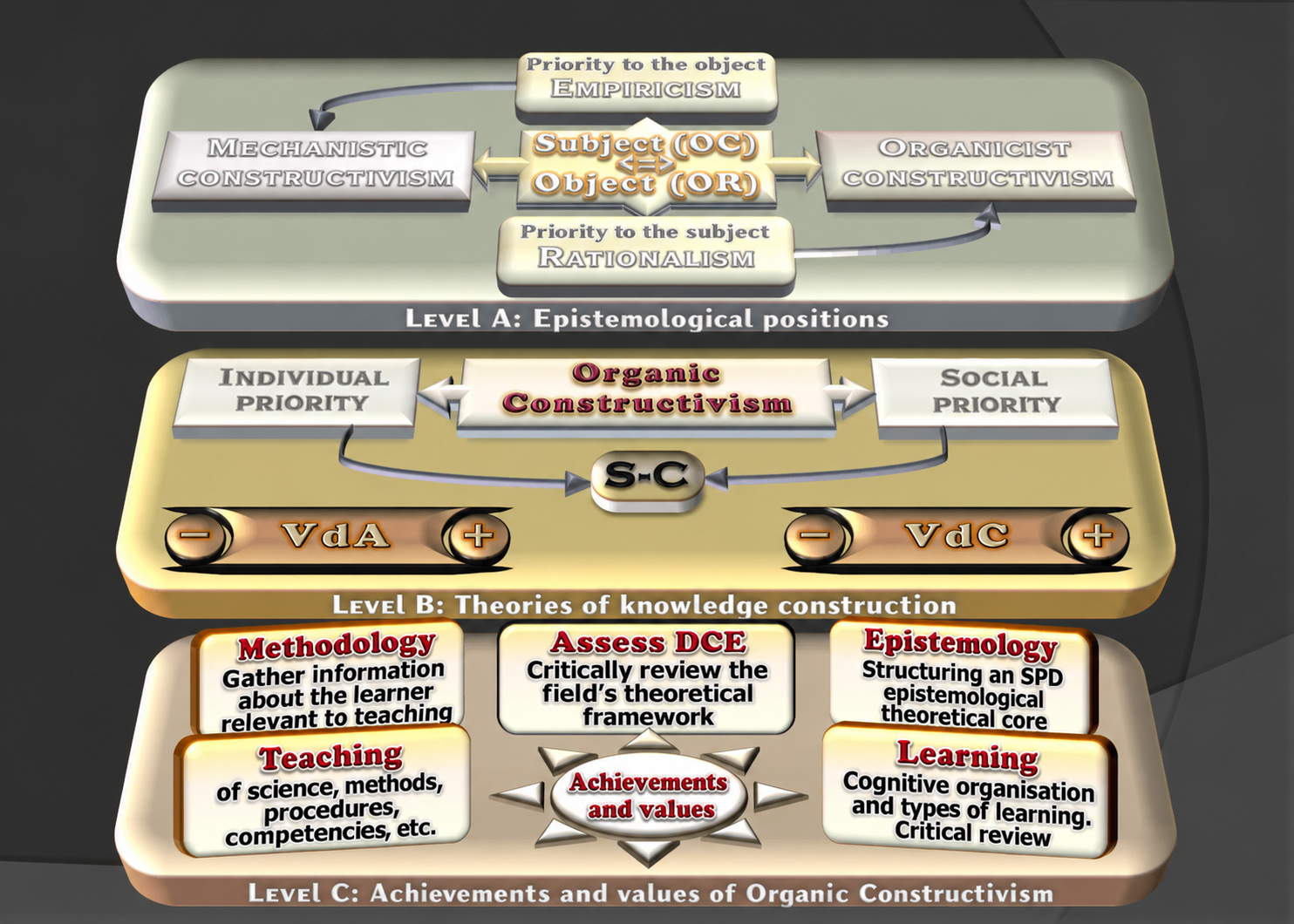
The levels of Organic Constructivism
Level A
Epistemological positions
Level B
Theories of knowledge construction
Level C
Achievements and values
Read the diagram text
- Priority to the object / Empiricism
- Mechanistic constructivism
- Subject (OC) / Object (OR)
- Organicist constructivism
- Priority to the subject / Rationalism
- Level A: Epistemological positions
- Individual priority
- Organic Constructivism
- Social priority
- Level B: Theories of knowledge construction
- Methodology
- Gather information about the learner relevant to teaching
- Assess DCE
- Critically review the field’s theoretical framework
- Epistemology
- Structuring an SPD epistemological theoretical core
- Teaching
- of science, methods, procedures, competencies, etc.
- Learning
- Cognitive organisation and types of learning. Critical review
- Achievements and values
- Level C: Achievements and values of Organic Constructivism
The underlying problem
Known object and real object
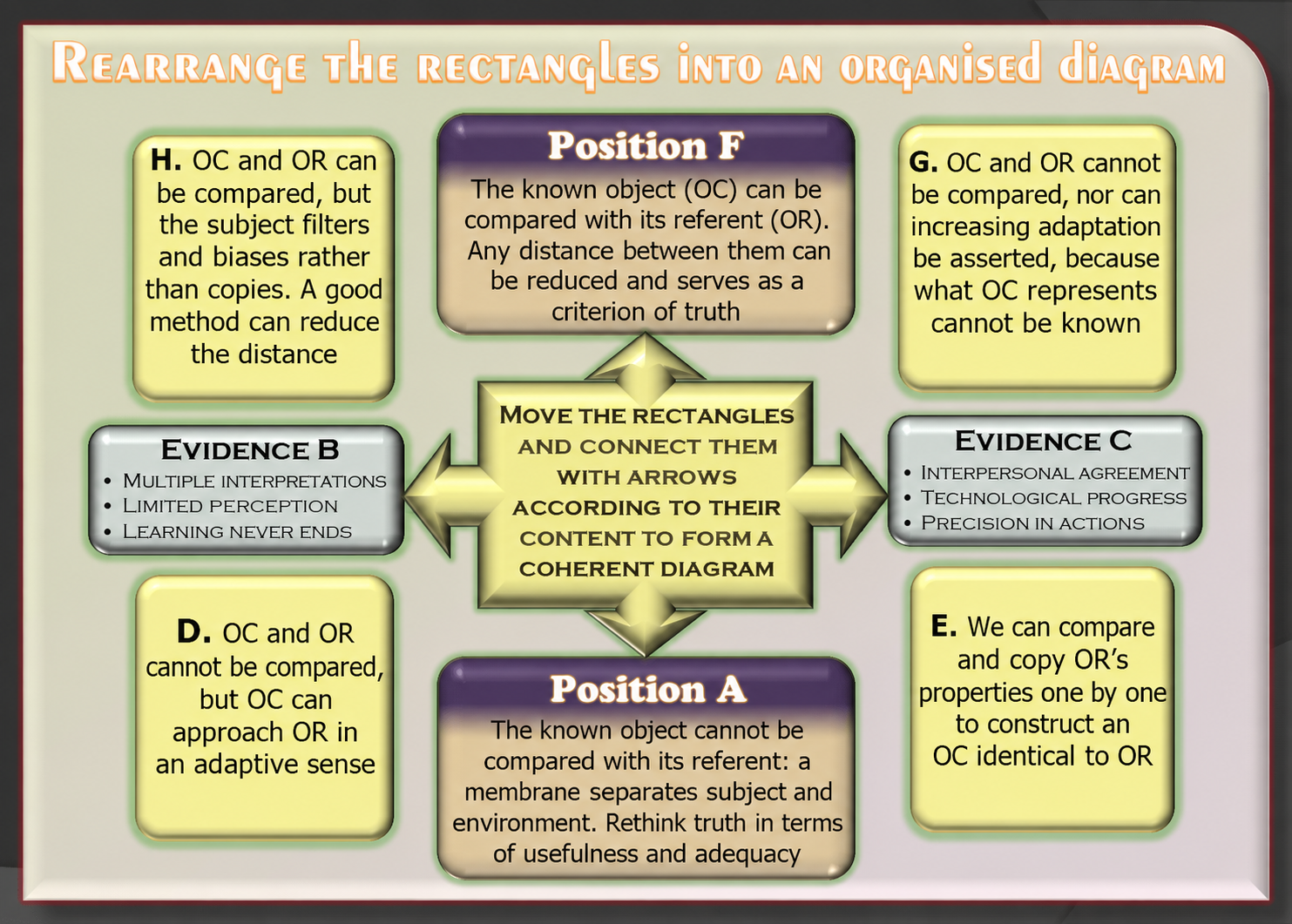
A central question concerns the relationship between the known object as constructed by the subject (OC) and the corresponding real object (OR). Two broad positions emerge.
One view allows comparison and treats greater similarity as greater truth. Everyday understanding, technology and sporting accuracy seem to support it; behaviourism and inductivism followed this approach.
The other denies direct comparison: constructed knowledge is internal, external reality outside. Different interpretations, limited perception and continuing learning suggest replacing truth-as-copy with usefulness, effectiveness, adequacy, prediction and coherence.
Organic Constructivism adopts this second position. It accepts reality while denying that we can place a mental construction beside its external object to check a match.
OC
Known object
OR
Real object
Read the diagram text
- Rearrange the rectangles into an organised diagram
- Position F
- The known object (OC) can be compared with its referent (OR). Any distance between them can be reduced and serves as a criterion of truth
- H. OC and OR can be compared, but the subject filters and biases rather than copies. A good method can reduce the distance
- G. OC and OR cannot be compared, nor can increasing adaptation be asserted, because what OC represents cannot be known
- Evidence B
- Multiple interpretations / Limited perception / Learning never ends
- Evidence C
- Interpersonal agreement / Technological progress / Precision in actions
- Move the rectangles and connect them with arrows according to their content to form a coherent diagram
- D. OC and OR cannot be compared, but OC can approach OR in an adaptive sense
- E. We can compare and copy OR’s properties one by one to construct an OC identical to OR
- Position A
- The known object cannot be compared with its referent: a membrane separates subject and environment. Rethink truth in terms of usefulness and adequacy
The philosophical “isms”
Organic Constructivism among philosophical positions
Empiricism
Experience dominates: the environment supposedly supplies information directly.
Rejected as a sufficient explanation.
Rationalism
Reason dominates construction, overlooking concrete environmental interaction.
Acceptable only within a developmental account.
Realism
Knowledge is assumed truer when it resembles external reality more closely.
Replaced by an adaptive criterion.
Idealism
Reality is treated as inaccessible, denying knowledge’s representation of or progress towards it.
Rejected: adaptive progress is possible.
Apriorism
Assumes cognitive structures are innate and preformed at birth.
Rejected: every structure has a genesis.
Mechanism
Reduces complexity to separable parts, additive wholes and linear causes.
Organic Constructivism’s methodological opposite.
Table 1
Dichotomous statement system (SaD-CO)
Less adequate · Empiricism
Approaches prioritising experience, reason or innate structures, assuming knowledge-reality correspondence or denying any adaptive progress towards reality.
More adequate · Constructivism
Knowledge develops through subject-object interaction, balancing experience and rational activity. Constructed and external realities remain distinct; progress is adaptive rather than a truth-by-copy criterion.
Less adequate · Mechanism
Machine models assume separable parts, an additive whole and simple linear causal relationships.
More adequate · Organicism
Knowledge is organic: the whole exceeds the sum of parts. Growing understanding changes both their relationships and how the parts themselves are defined.
Individual knowledge
Four pairs to understand learners
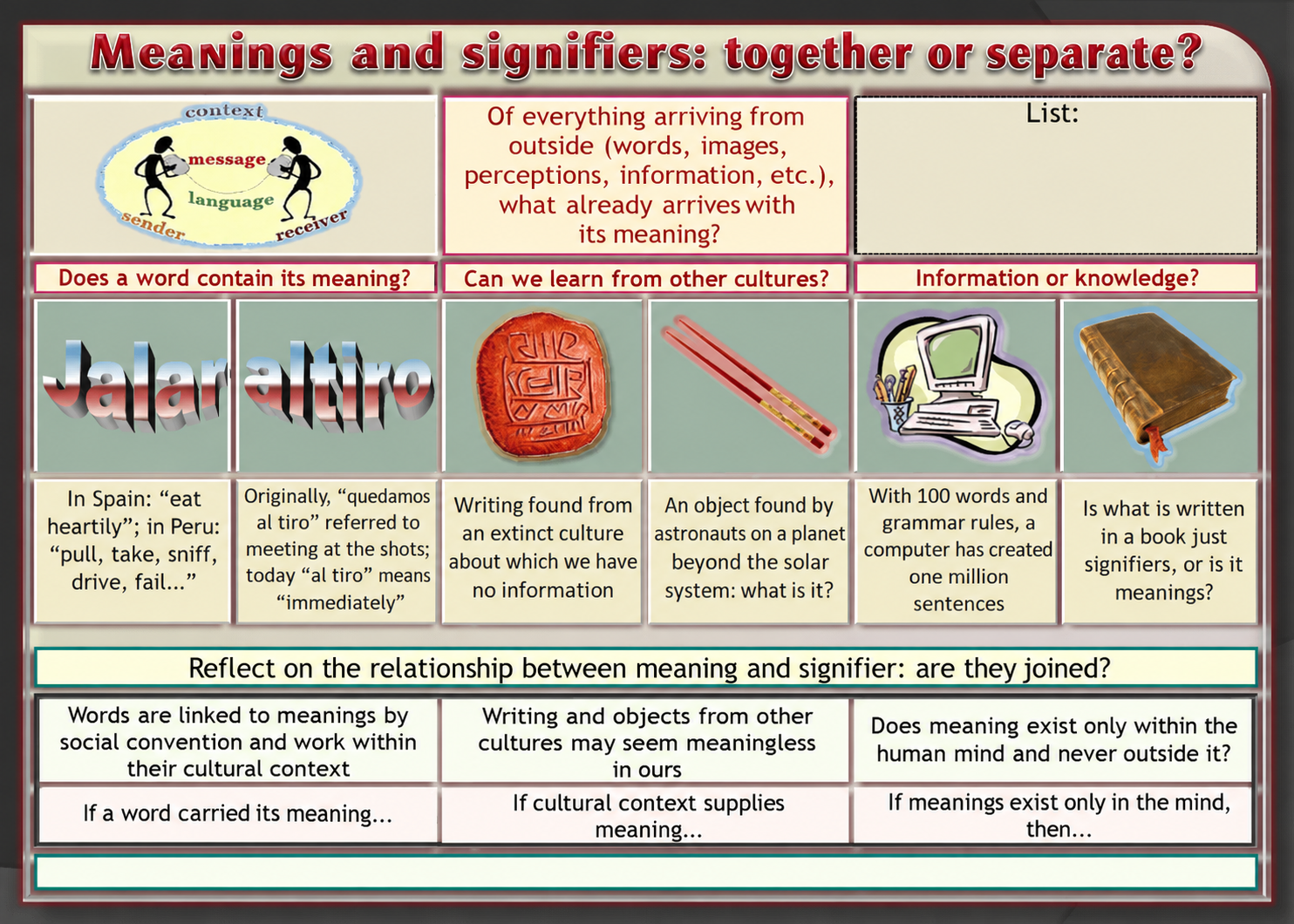
For Organic Constructivism, the signifier is anything arriving from outside: words, symbols, images, perceptions and formulas. The meaning does not travel with it: subjects construct it through experience, emotion and prior knowledge. Information circulates; it becomes knowledge within the mind.
Hence the gap between teaching and learning. Teaching presents content; learning assimilates it internally. Even excellent strategies may or may not produce learning.
The third pair contrasts concept and schema. Concepts suit exchange in semiotic communities such as science. Individual knowledge is also implicit, procedural, embodied and emotional; schemas describe it better.
The fourth pair distinguishes logic from psychology. Academic categories can make learners appear inconsistent. Their own knowledge is often coherent, useful and adapted to their environment through organic self-regulation.
Across all four pairs runs an embodied view of knowledge that overcomes body/mind, subject/object, reason/emotion and procedural/conceptual divisions.
Read the diagram text
- Meanings and signifiers: together or separate?
- context
- message
- language
- sender
- receiver
- Of everything arriving from outside (words, images, perceptions, information, etc.), what already arrives with its meaning?
- List:
- Does a word contain its meaning?
- Can we learn from other cultures?
- Information or knowledge?
- In Spain: “eat heartily”; in Peru: “pull, take, sniff, drive, fail…”
- Originally, “quedamos al tiro” referred to meeting at the shots; today “al tiro” means “immediately”
- Writing found from an extinct culture about which we have no information
- An object found by astronauts on a planet beyond the solar system: what is it?
- With 100 words and grammar rules, a computer has created one million sentences
- Is what is written in a book just signifiers, or is it meanings?
- Reflect on the relationship between meaning and signifier: are they joined?
- Words are linked to meanings by social convention and work within their cultural context
- Writing and objects from other cultures may seem meaningless in ours
- Does meaning exist only within the human mind and never outside it?
- If a word carried its meaning…
- If cultural context supplies meaning…
- If meanings exist only in the mind, then…
Table 2
Dichotomous statements about learners (SaD-VdA)
Less adequate · Empiricism
Assuming external signs, symbols and sensations arrive with meaning, or that learners can acquire everything taught through sufficient teaching effort.
More adequate · Constructivism
Subjects assign meaning with their whole biological, emotional and cognitive being. Meanings vary by degree and differ between teachers and learners.
Less adequate · Empiricism
Assuming direct causal links between teaching conditions and learning outcomes, with learners able to acquire everything taught easily.
More adequate · Constructivism
Teaching and learning differ in nature. However favourable the conditions, construction occurs internally and remains demanding.
Less adequate · Mechanism
Treating learners’ knowledge as a hierarchy of precisely defined concepts connected through logical class relations.
More adequate · Organicism
Cognition includes stable experiential, procedural and implicit structures strongly linked to emotion, needed to assign meaning.
Less adequate · Mechanism
Academic logic introduces bias, making subjects appear fragmented or confused when they are not.
More adequate · Organicism
Psychologically informed frameworks reduce bias and reveal more coherent, pragmatic problem-solving within the subject’s environment.
The social extension
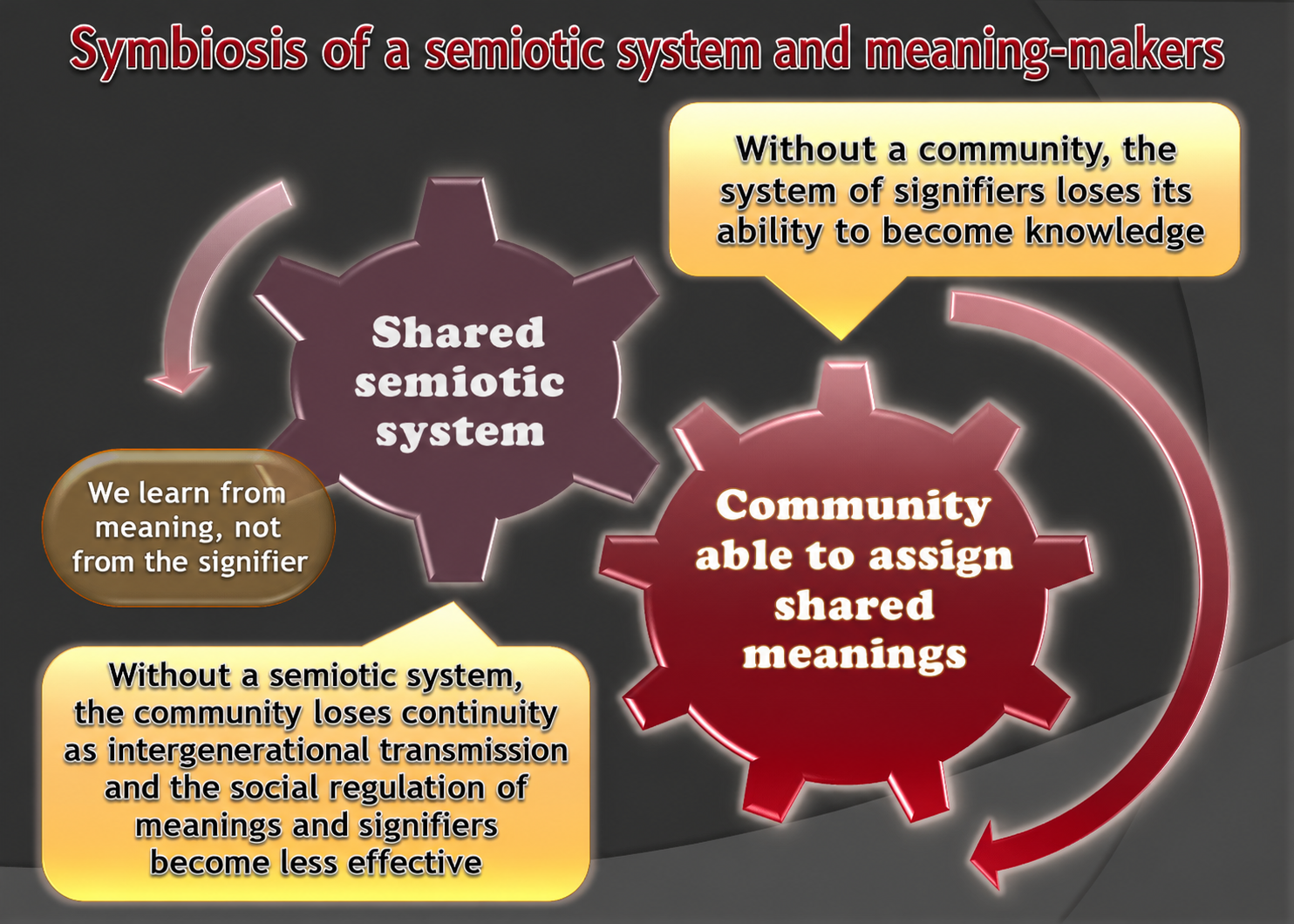
Semiotic-community symbiosis
System of signifiers
Community of meanings
Communication encourages personal meanings to align with communal meanings, while individual contributions transform the community. Developed in module 5.
Read the diagram text
- Symbiosis of a semiotic system and meaning-makers
- Shared semiotic system
- Community able to assign shared meanings
- Without a community, the system of signifiers loses its ability to become knowledge
- Without a semiotic system, the community loses continuity as intergenerational transmission and the social regulation of meanings and signifiers become less effective
- We learn from meaning, not from the signifier
Scientific knowledge
The distinctive nature of scientific knowledge
Scientific knowledge’s identity depends on a community that agrees, manages and uses its conceptual resources. The self-regulating entity is science’s S-C system.
Success depends especially on managing the semiotic system through two factors: strong social regulation, reinforcing symbiosis, stability, continuity and the training of new members, and strong empirical regulation, continually confronting a stable core of semiotic materials with evidence.
Table 3
Dichotomous statements about science (SaD-VdC)
Less adequate · Empiricism
Science treated as direct generalisation from observation, a theory-free reflection of natural laws, complete, exact and produced in neutral contexts.
More adequate · Constructivism
Science develops through dialogue between theory and theory-laden evidence. Its value is usefulness; its development responds to contemporary problems.
Less adequate · Mechanism
Science treated as linear accumulation through one universal, infallible method and the contributions of isolated geniuses.
More adequate · Organicism
Progress is collective, complex, usually evolutionary and sometimes revolutionary. Scientific methods vary across discovery, communication, regulation and justification.
Tables 2 and 3 differ in their knowledge contexts but show structural parallels despite originating in different literatures: psychology and philosophy of science.